The events in this story unfolded over several years and involve many people from Isperih and elsewhere. Some may like it, others may not. But there are still living people who likely remember particular moments of it well.
I will begin a little from afar.
The first director of the Historical Museum – Isperih, Mr Yordan Stefanov, retired on 23 December 1991, and for about six months until a competition was held the post was filled part-time by Mr Boshnakov, then director of the Education and Culture Directorate at the Municipality. Throughout that time the museum archive remained under lock and key, because Mr Stefanov did not want to hand the documentation over to the acting director. On 4 June I received my appointment order, and the next day – the key to the enormous archive of the museum’s official documents. Among the contracts were some whose term had not yet expired, and one of them was with the Institute of Experimental Morphology, Pathology and Anthropology of the Bulgarian Academy of Sciences for the plastic reconstruction of three faces from different periods, based on skulls found in the Archaeological Reserve “Sboryanovo”. I immediately recalled how, in the autumn of 1991, I had sent human bone material from the excavations at Sboryanovo to that institute. The cheapest way was by railway container. When the clerk at the Isperih station realised what I was shipping, he joked that if “that man” were alive he would pay 18 leva for a ticket to Sofia, but now he was paying only 13. I told him it was actually a group ticket – twelve “people” were travelling – and his smile froze.
An advance payment had already been made under the contract. Facial reconstruction from the skull was – and still is – slow, meticulous and highly specialised work that only one person in Bulgaria could then carry out: Prof. Yordan Yordanov, a student of the Soviet Professor Gerasimov, the author of the method of plastic facial reconstruction from the skull. Given the nature of the work, the contract term was very long – about three years – and I promptly forgot about it.
In the hard winter of 1994 in every respect, a very angry man rang me. He introduced himself as Professor Yordanov, anthropologist and director of the Institute of Experimental Morphology, and said that we had commissioned work we had not paid for, and that in the coming days he would hand the facial reconstructions from Sboryanovo skulls over to the Archaeological Institute at BAS. Professor Gergova (then still only a doctor) had allegedly told him that we had paid nothing and could not pay now. I fell into a three-second stupor, then tried to explain that we had paid about one third of the contract sum in advance and had documents for it, but he would accept no explanations. He simply did not believe me and slammed down the receiver. After all – my word against that of a Sofia scholar from BAS. The next morning we were already in Sofia at the Institute with the late Veska Karadzhova (the museum accountant), copies of all available documents in hand, ready for a long verbal “battle”. To our relief the misunderstanding was cleared up at once. The conversation became pleasant; our long-time acquaintance Dr Slavi Cholakov, a collaborator of the professor, joined in, and Professor Yordanov himself proved a charming and hospitable host and asked his colleague for coffee… Wonderful! That is how we learned that Mr Stefanov’s idea had been for one reconstruction to be the face of the woman buried in the Sveshtari tomb. Study showed that parts of her skull were missing, making the work impossible. According to Professor Yordanov the blow to the back of the head that killed the Thracian chieftain’s wife had been so strong that it carried away many of the bones important for his work. I tried to say that, according to Herodotus, Thracian women voluntarily followed their husbands into the afterlife. The professor briefly replied that he trusted the material evidence, according to which there could be no talk of voluntariness – and with that evaporated the last traces of archaeological romance in my head. He consolingly added that in her place had been “slotted in” a woman from the Chalcolithic (Copper – Stone Age, 5th – 4th millennium BC). Unable to reconstruct the Thracian woman’s face, Mr Stefanov had given him leave to choose any of the eleven skeletons sent with her. The professor chose precisely that woman for her excellently preserved skull, remarkable stature of 1.65 m (when the average for the period was under 1.60 m) and age of about 40 – 45 years (average for the Chalcolithic 30 – 36). My teeth almost squeaked with joy – that was a skeleton from my own excavations of the prehistoric necropolis at Demir Baba Tekke. What a coincidence!
Dr Cholakov brought the cast wrapped in white paper. He carefully unfolded the packaging, and we cried with one voice: “Oh, but you’ve made her so ugly…” She was ugly, and still is – anyone who saw her in the now-removed exhibition of the Historical Museum – Isperih knows. And Professor Yordanov: “Well, I hesitated a good deal and checked several times whether I hadn’t erred with those ‘dreaming’ lips, but that matches the skull exactly. Luckily yesterday on the tram I met a little woman with exactly that facial angle and such a little mouth, and I was reassured.” Then they brought the second reconstruction – of the priestess from the Early Iron Age (10th – 9th c. BC), from excavations by (now) Prof. Totko Stoyanov, again from Sboryanovo. They left us to unpack it; our hands were shaking – what would this one look like? – and Veseto Karadzhova exclaimed: “Ooo, the mother of Kolyu Otrovata!” In the early 1990s the chair of the Municipal Council in Isperih was Mr Nikola Nikolov, known as Kolyu Otrovata because of his work in plant protection, and a neighbour of Veska. The face of the priestess from 3,000 years ago remarkably recalled that man’s features. We agreed that they would give us the reconstructions of the priestess and of the chieftain from Mound No. 13 (4th c. BC, excavations by Prof. Gergova), which was not yet finished, according to the payment and delivery schedule in the contract. They even promised to bring them in person – and not only that, but to mount free of charge for us an exhibition with the reconstructions of “our” people and of several Bulgarian historical figures from the Early Middle Ages and the National Revival.
Prof. Yordanov kept his promise and in late autumn 1995 arrived with a minibus of plastic reconstructions and two colleagues. The cold was bitter; the Orpheus tourist house (called for short “the Tourist”) had no central heating, and electric heaters were not allowed because electricity was expensive. There were no other hotels in town then, and at the Ahinora hut the cold and cleanliness were tragic. Accordingly the professor said he would load his people and materials and go mount the exhibition in Razgrad – it was simply impossible to live here. What now?! So – with apologies to Zhoro Varbanov – we secretly brought in two electric heaters hidden in small travel bags, warmed the frozen scholars, and thus saved both the exhibition and the honour of the town and the museum.
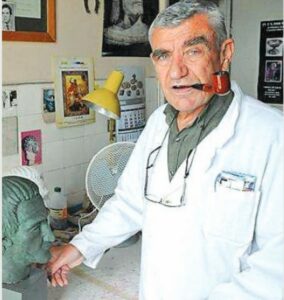
The day before the opening Prof. Yordanov gave an interview for Radio Isperih and spoke about his work; as already noted, he was a wonderfully eloquent speaker. I have not yet said that he was also a man of striking appearance – a little under sixty, tall, lean, dark-complexioned, with greying black hair and piercing blue eyes. He smoked a pipe with aromatic tobacco, and bluish clouds of tobacco smoke scented with cherry leaves drifted about him. He was noticeable from afar; many people had already met him on the main street, and curiosity had its say. A great crowd gathered for the exhibition opening; the Art Gallery hall was packed – mainly women from the pensioners’ club and their friends, teachers, community-centre activists, and anyone who had heard the radio interview. We set up a small screen with a slide projector, and Prof. Yordanov delivered a “short” lecture that, with extra questions, lasted almost an hour. He spoke of ancient diseases, bones and death – in his usual lightly humorous manner – walking back and forth and waving his pipe to point at something in the slides, while fragrant smoke rose from it as from a censer. Need I say that everyone, especially the older women, watched him “with awe and open mouths”? He had to give another, slightly shorter lecture for additional listeners. Two months later we returned the exhibition, but for years afterwards some pensioner would still ask when we met: “Won’t you invite again that handsome man with the pipe who spoke so beautifully about the dead?”
After these events we regularly received invitations to various occasions at the Institute of Experimental Morphology, Pathology and Anthropology of BAS. Not all of them were attended by our representative, but we never failed to send a holiday card and congratulations on Prof. Yordanov’s jubilee dates.
In this photograph the professor is 75. He died at 83 in February 2022. May his memory be bright!
Boryana Mateva
Director of the Historical Museum – Isperih (1 June 1992 – 17 January 2018)